by Jol Stoffers, Ph.D (Master Program in Management, UNPAR)
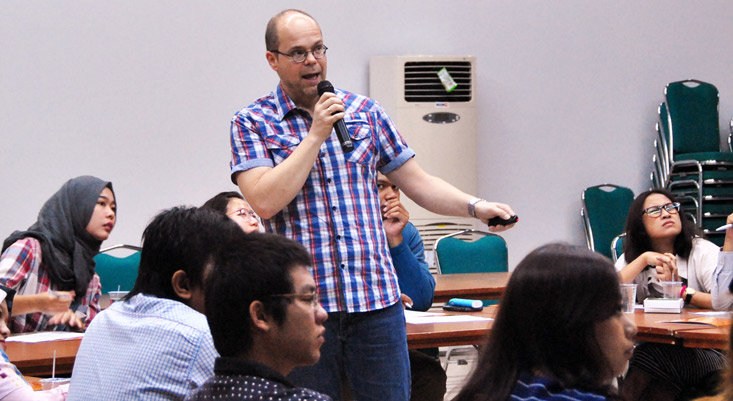
Leadership is one of the most important things in management, which supports the achievement of goals/objectives effectively. Master Program in Management (Magister Manajemen) UNPAR has a special program on Leadership through a workshop and a class taught by the expert in this field. Jol Stroffers, Ph.D is one of our experts who shares his thoughts in this article on leadership challenges in 21st century.
Leaders around the world are faced with ambiguous challenges. They have to supervise and motivate a diversified group of employees, improve efficiency, innovate, achieve growth, and meet various stakeholders’ expectations. Leaders have to work across cultural boundaries and collaborate with other professionals who differ not only in personality and background, but also in their approach to the work that needs to be accomplished.
The rising tide of globalization calls for generic global leadership styles, often learned from management books based on Anglo-Western business perspectives. These perspectives usually lack a diversity of styles. From my own experience as a lecturer and partner in dialogues about Leadership in Context in Southeast Asia, Europe, USA, and West Africa, it appears that effective leadership styles vary per continent. Therefore, I strongly believe that regional context-related best practices should not be ignored. Today’s leadership should be a symbiosis between global insights and the specific regional context – which region could be delineated by either geographic or nongeographic dimensions such as culture, politics, and economics.
The issue of a leadership style according to a regional context is particularly important to small and medium-sized enterprises (SMEs). These are responsible for most of the world’s trade and growth. Representing 95% of all the global enterprises and thereby 60% of all the jobs in the private sector, SMEs are the key drivers behind innovation, social integration, and employment. The hierarchy within SMEs, which is relatively flatter than in large organisations, can be found to be going hand in hand with shorter lines of communication between leaders and employees. This allows employees to understand their leaders better and adjust their work behaviour to the specific requirements of the company.
Despite a global market, trade in the second half of the twentieth century was driving more activity within than across regions. The adoption of a regionally oriented strategy in addition to a global outlook has helped culturally linked leadership styles and practices evolve. Scientific research reveals that different leadership behaviours are understood and evaluated differently depending on their cultural setting and are due to differences in employees’ beliefs of the best leader.
An illustration of the idea of a leadership symbiosis between global insights and specific regional context was made by Jogulu (2010). This research supports the idea that culture and leadership interact in different ways in different contexts. The Anglo-Western leadership framework of transformational and transactional leadership (Avolio & Bass, 2004) was used to assess samples from Malaysia and Australia, which countries represent different cultural traditions: an Asian and an Anglo-Western culture, respectively. Transactional leadership (focused on planning, organising and coordinating) was found to be correlated with Malaysian leadership effectiveness, whereas transformational leadership (aimed at inspiring and motivating) explained the effectiveness of Australian leaders. In Malaysia, the high power distance (Hofstede, 2010) is argued to have influenced the leadership style, because this culture favours an autocratic leadership style. Employees are expected to accept their leaders’ orders and direction more willingly out of respect for people in power. In the Australian context where freedom and autonomy is essential (low power distance, Hofstede, 2010), transformational leadership is a better means to the same end.
A growing number of recent leadership theories imply that leadership styles are transforming to keep up with globalization, a one-size-fits-all approach. This article opposes to this line of reasoning and argues in favour of a symbiosis between global insights and the specific regional context for 21st century leadership. In my view, the connection between leadership styles and regional contexts cannot be unobserved.
Biographical Notes:
Jol Stoffers, PhD (1969) is professor of Employability at Zuyd University of Applied Sciences (Netherlands, Europe); he leads the Research Centre of Employability. Next to that, he is an academic program manager of the master degree Leadership in Innovation and Change. He is also teach at Master Program in Management (Magister Manajemen) of UNPAR in Bandung and affiliated with the Technical University Ho (Ghana, West Africa). Jol Stoffers holds a PhD in Management Science. His research has been published in international peer-reviewed journals, including Journal of Organisational Change Management.
References:
-Avolio, B. & Bass, B. (2004). Multifactor Leadership Questionnaire. Mind Garden, Menlo Park.
-Hofstede, G., Hofstede, G.J., Minkov, M. (2010). Cultures and organizations: software of the Mind, McGraw Hill, New York.
-Gentry, W.A., Eckert, R.H., Stawiski, S.A., & Zhao, S. (2016). The challenges leaders face around the world: more similar than different. Center for Creative Leadership, USA.
-Ghemawat, P. (2015). Regional strategies for global leadership. Harvard Business Review, 83(12), 89–108.
-Jogulu, U.D. (2010). Culturally‐linked leadership styles. Leadership & Organization Development Journal, 31(8), 705–719.