By: UNPAR Publication Section
Uneven distribution of development often results in people’s inability to fulfill their basic living needs. It indicates the lack or the absence of development that touches the local commuity’s needs, especially those in rural areas.
In practice, the government has enacted varieties of efforts to enable independent and advanced rural communities. Based on the Law No 6 of 2014 concerning rural areas, the government hopes that rural communities can be prosperous through the fulfillment of their basic needs, infrastructure development, local economic potential development, and the utilization of environmental and natural resources.
However, is it true that the enactnment of the law really enables the rural community to make progress and be independent all by themselves?
The Role of Higher Education
Community service, as the third pillar in the Tri Dharma of higher education (the three main responsibilities), is translated into an activity aimed at improving the quality of human resources in terms of broadening insight and knowledge as well as improving skills.
Organizing the community service program is a form of Tri Dharma as well as a form of the academic community’s awareness to play an active role in improving society’s welfare and empowerment, especally those of the lower economic classes.
In line with Parahyangan Catholic University’s motto/vision “Bakuning Hyang Mrih Guna Santyaya Bhakti” which means “Based on divinity, searching for knowledge to be dedicated to the society”, UNPAR students have the responsibility to dedicate the knowledge they gained during their university years to the local community through community service programs.
The Bakti desa program (rural service) is an option of community service through the empowerment of local potential. In addition to theoretical contribution, there is also a practical aspect of the program by way of concrete acts of creating balance between the continuos element of development such as: economic, social and environmental dimensions.
On the other hand, the issue of develoment is not only about macro-economics objective, but also the human dimension. This means that the process of “development” will involve the dimension of community empowerment. the community does not only act/ as a passive object, but also as the enactors of development ready to express their opinion, determine life choices and participate in government.
In principle, developing the community is part of social responsibilities in the Tri Dharma of higher education.
UNPAR, through the Lembaga Kepresidenan Mahasiswa/Students Presidency (LKM UNPAR) is in the process of conducting a program called TOSAYA (TOSAYA is an acronym for Ngabantos Sadaya (Sundanese) which literally means helping each other. Through this program, UNPAR hopes to conduct a longlasting community service program.
Based on past observations, the village of Tanimulya, Kecamatan Ngamprah, Kabupaten Bandung Barat (the West Bandung Regency) was chosen as the target for TOSAYA 2016.
Autonomy
With the theme “Membangun Bangsa dari Desa” /Building the nation from rural areas, TOSAYA was enacted due to the phenomena of the Tanimulya Villagers’ inability to process local resources. After seeing such conditions, LKM UNPAR was moved and decided to conduct several activities guided by the principle of sustainability. Thus, at the end of TOSAYA, the local community will not experience dependency, but, they will become an independent society in developing and utilizing existing potential instead.
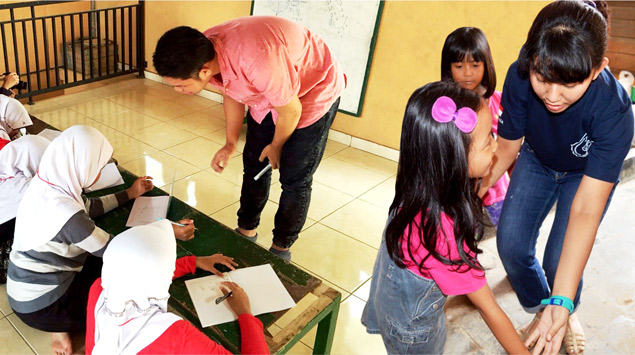
TOSAYA has been conducted with concepts of being educative, informative, attractive, interactive and conducive. Several activities that have been carried out are familiarization, hydrophonics training program, health and nutrition counseling, Dengue Fever counseling as well as the teaching of English, Mathematics and traditional dance to elementary and junior high school students.
Through TOSAYA, the citizens of Tanimulya village have received socialization and education concerning practices of waste management, desain and budgetting of local village projects. Some collaborative programs that have been conducted are the construction of Pos Ronda (Nightwatch post); PAUD (Early Childhood education) facility renovation; village program collaboration in budgetting and designing the drainage system, a Futsal (indoor mini soccer) court and Tanimulya village Mushala (Moslem Prayer room); a career clinic and donation of educational aids to help students in learning processes.
Hopefully, the TOSAYA will have a sustainable effect, from environmental, economic and social aspects on the citizens of Tanimulya Village.
Source: KOMPAS-Griya Ilmu (Thuesday, March 1 2016)