In essence, Intellectual Property Rights/ Hak Kekayaan Intelektual (HaKI) is a reward (Economic) for ideas or results of intellectual thinking. Intellectual creativity can take the form of product or process that has utility for human life. Therefore, Haki is private in nature and can be requested on a personal basis.
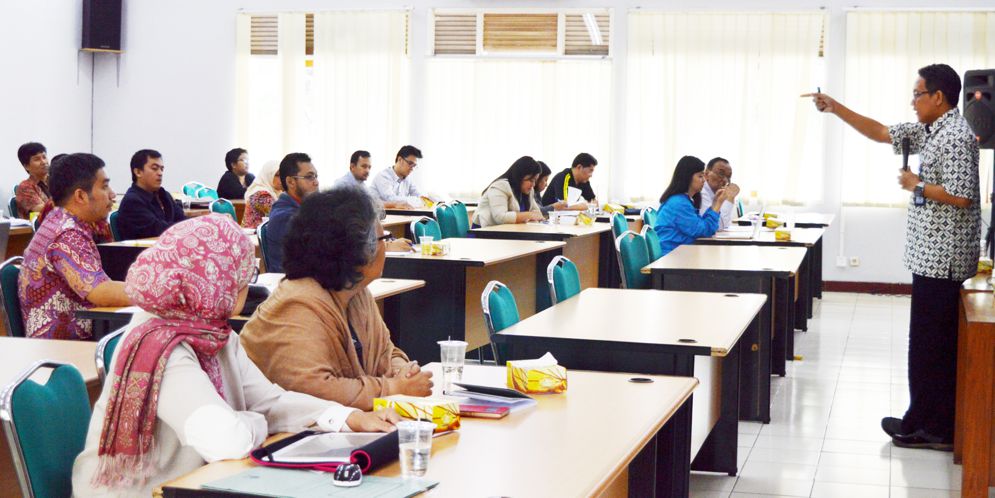
On Thursday (17/12) / the Research and Community Service Institute (Lembaga Penelitian dan Pengabdian Pada Masyarakat) (LPPM UNPAR) hosted a workshop on Intellectual Property Rights. Mr. Ir. M. Zainudin, M.Eng from the Directorate of Patent, Directorate General of Intellectual Rights, Ministry of Law and Human Rights of the Republic of Indonesia, who acted as the keynote speaker began his talk with a description of the general information of Intellectual Property Rights and narrowed down to a description of the patent system and the procedure to receive a patent.
In general Intellectual Property Rights is divided into two, namely Copyrights and Industrial Property Rights; patent is in the purview of Industrial Property Rights.
In Indonesia, an exclusive right given by the country to actors of Intellectual Property Rights has not been utilized optimally. In his talk, Mr. Zainudin explained that the USA and Japan rank first and second in terms of the highest number of patent applications in Indonesia in 2009 – 2011. Therefore, 89% of patent applicants are foreign parties and only 11% are domestic in nature. The data shows that Indonesians do not have the know-how or sufficient interest in applying for patent rights, even though the country charges very low fees between 250.000,00 IDR to 3.000.000,00 IDR.
The reasoning behind the workshop held by LPPM UNPAR is the existence of external research projects that demand Intellectual Property Rights as the final outcomes, while at the same time UNPAR’s lecturers are lacking in terms of comprehension of the process to obtain copyrights or patent; the reasoning also includes the Intellectual Property Rights component in UNPAR’s study program accreditation.
Therefore, in the coming 2016, LPPM UNPAR will aid the process and the financing of copyrights for lecturers who have produced works such as books, software, cinematography, visual aids, architectural designs, modules and translation in the form of CD, as well as technology-based research and social engineering.
The beginning of the protection of the Intellectual Property Rights will hopefully give a boost for lecturers to conduct collaboration between social and political based research. On the other hand, through gaining copyrights and patents, the intellectual creativity of UNPAR lecturers can be appreciated and financially beneficial.