Students who study in Architectural Study Program of Parahyangan Catholic University (Unpar) have numerous opportunities to develop themselves in student organizations. One of these is Arsitektur Hijau/Green Architecture (Arjau), a venue for accomodating students’ interest which is part of the Unpar Student Association of the Architecture Study Program (HMPSARS).
To date, there have been 33 batches of Arjau as a result of this initiative. This year, twenty-nine young Arjau members who are members of Nirbita Agnimaya’s batch developed themselves in the Basic Training held at Kampung Pasir Malang, in the South Bandung area. The results they attained in this training were summarized, documented, and disseminated to the general public in exhibitions and presentations held between March 18 and 23, 2018.
In the exhibition entitled “Shape, Space, and Order of RW 04 Pasir Malang: the Expression of Space in Fog”, the participants of Arjau Basic Training presented the results of data collection conducted from January 15 to 21, 2018. For one week, the students conducted data collection of various vernacular architectural aspects that exist in the region. They also documented the daily life and traditions of the village community to understand the relationship between the daily life of the people and the architecture of the region.
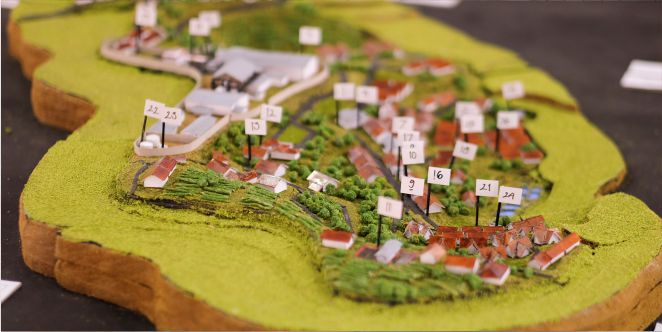
 The Unpar Publication Team who visited the Exhibition on Wednesday (21/3) and then had an interesting impression when entering the exhibition area. The Lobby was dominated by an installation that describes the condition of space and architecture in Kampung Pasir Malang. Various forms of buildings that have specific functions are presented in the form of a model, ranging from residence to communal space as well as cattle stables.
The exhibition also featured documentation in the form of photographs and sketches that captured the daily life of the Pasir Malang community as well as students during their experience. People who mostly work as farmers rely on the factories and tea plantations in the middle of the village. This lends its own characteristics to the pattern of settlement and of course the existing architecture in Kampung Pasir Malang.
Citing the official website of Arjau, this organization is the embodiment of student interest in vernacular architectural objects in Indonesia. Since its founding in Mount Papandayan in 1985, various Arjau batches have traveled all over the country to preserve the vernacular architecture as part of the nation’s cultural treasures.