The phenomena of environmental damage can happen due to natural or man-made events. Earthquakes, mountain eruptions, hurricanes are examples of unavoidable natural events. But how about forest fire, soil degradation, environmental pollution or ecosystem damage; who should we blame?
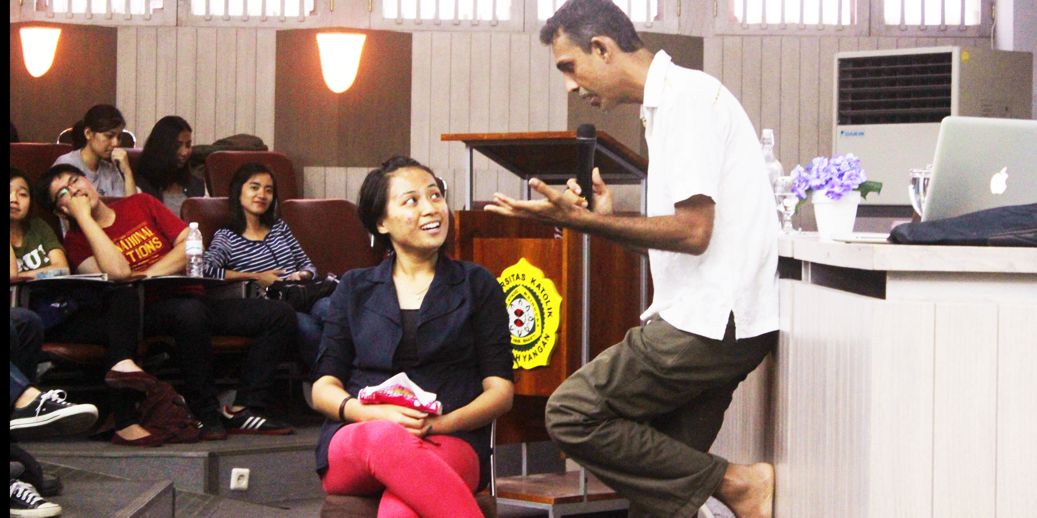
On Monday (9/11), Gobind Vashdev (the bestseller author of “Happiness Inside”), became the keynote speaker for the International Relations Study Program Guest lecture, entitled “Development and Environment: “Does the environment have to be the victim of development?”
Through videos and illustrations, the speaker gave a new perspective on development issues and environmental damage. We cannot deny that development walk hand in hand with technological advancement, which in turn has brought forward a modern human lifestyle. Unfortunately, the development process often disregards its side effects on the environment.
“……what is the most important action we can initiate to save the earth from environmental damage?” asked Gobind to the attending students in the Mgr. Geisse Lecture Theatre FISIP. Some answered based on their knowledge like by not littering and doing the 3R principle “Reduce, Reuse, and Recycle”
To answer a similar question, based on Gobind’s research, 23% out of 1089 respondents thought that the way to save the earth from environmental damage is by saving; both energy and water saving. Second came those (with a percentage of 21% respondents), who thought that before committing real acts humans have to develop individual self-awareness. Waste management and tree planting consecutively came third and fourth with 21% and 17%, respectively.
In response to the survey result, Gobind explained that the answers and opinions came from the general knowledge we had gained. They are not wrong, but there is one main thing we can do, by changing our lifestyle, specifically by reducing meat consumption.
“Do you know that a single human being can finish 16 pounds of wheat, 8 kg of soy bean, 6 kg of corn and 2400 gallons of water in every meal?” Gobind asked the trivial question to the audience. Apparently the aforementioned amount is what is required to produce a single pound of meat. The questions and suggestions presented by Gobind seemed like a form of propaganda for us to become a vegan, but he invited us to see this phenomenon in a more holistic way.
The action to reduce meat consumption to reduce environmental damage is in line with a report from the Food and Agriculture Organization of the United Nations (FAO). The report indicates that the poultry/farming sector is a significant contributor to environmental damage. The sector produces greenhouse gasses emission equal to 18% CO2 and Methane gas that caused a heating effect that is 23 times more powerful than CO2.
Gobind is a vegan, but he does it out of his love for animals and his compassion for the nature that has been so kind to human beings. Now the question posed to us is where do we take the direction of our country’s development and what can motivate us to consistently protect the earth from environmental damage.
“Nature will be fine without Humans, but Human will be nothing without nature”, as summed up by Gobind followed by applause from the students.