Bandung, Kabar kampus– Komisi Nasional Perempuan /the National Commission for Women (Komnas) revealed the existence of discriminative public policies towards women and minorities. These policies are spread across several areas in Indonesia.
Indrawari, a commissioner in the Commission, stated that the discriminative policies are in the forms of Peraturan Daerah/ Local Government regulation (Perda). The contents of those regulations are often in conflict with the higher sets of regulations, namely law.
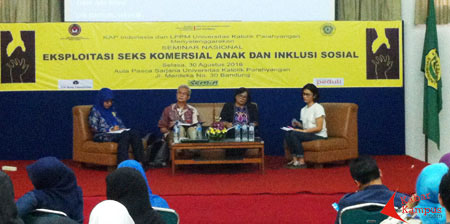
“up to August 2016, there have been 421 public policies that are discriminative towards women and the minorities.” Indrawari added. In a national seminar titled “Eksploitasi Seks Komersial Anak dan Inklusi Sosial”/”Children Commercial Sex Exploitation and Social Inclusion” held by KAP and LPPM Unpar at Parahyangan Catholic University (Unpar), on Merdeka street, Bandung, Tuesday (30/8/2016).
Those discriminative local government regulations regulate women’s behavior, such as the way they dress, women in public space. Many of those regulations also discriminate minority groups such as religious and belief groups.
“Currently, the local governments act as if they are small kingdoms that create regulations that are against higher law stature”.
Indrawari then added based on Law number 23/2014 concerning Local Government, local regulations that are in opposition to their higher regulations can be revoked by the minister. Law number 23/2014 concerning local government states that no local regulations can go against human rights.
“The law is more advanced as it enables a minister to revoke local regulations that are against/in opposition with the higher regulations and human rights. Before it was released, the cancellation of regulations can only be revoked by the president. Now a minister has the same authority,” added Indrawari.
The National Commission of Women also noted laws that go against one another such as Law number 23 of 2004 concerning domestic violence, is ineffective in protecting women and children.
“factually, this law has been in effect for 12 years,” she said.
According to her, there is a way out of the law that can criminalize women as victims. This has been made worse by the apparent weakness of the law enforcement in comprehending domestic violence cases against women and children. The state apparatus has been accused of not having the proper gender perspective.
Oftentimes in the field, law enforcement officers advise the victims not to pursue domestic violence legally.
“As for domestic violence, the solution is divorce, to get women away from the perpetrators while the perpetrators themselves are free and this opens up the possibility of a repeat offence” She added.
Another example of inconsistencies between laws is the failure to define the correct children’s range of age. This inconsistency has made it possible for underage marriage.
“around 42 percent women married at the age of 15-19 years old,” as a result, these early marriages have become the major cause of mother and children’s’ deaths. Hence the current ranking of Indonesia as a country with the highest number of mother and children’s’ deaths in Asia.
Source: kabarkampus.com